Let's be clear. Packs are for carrying stuff. The things in your pack should make you feel happy, safe, secure, and full. Each hiker must choose their comfort level. This is my take on when and why you should take a certain pack... and why I have so many packs!!
The Daypack
This pack type will consistently get more use than all other packs. You'll use it to go on the day hike, to go to the beach, to go traveling overseas or to festivals. Basically a man-purse (but for women too), but much more... manly (or womanly)!
If you pack correctly, the day pack can be used for a weekend overnighter too. Super UL and you'll have room to spare in your gunny.
The size comfort and cost of a day pack is really negligible. I wouldn't stress about this at all. I have one that was ~$90 with padded straps, bladder pouch, cinches, waste and chest snaps. And I have one that packs down to a small size with no frills at ~$25. Both work exactly the same - fits on the back to carry a snack.
Shoe pairing: Lightweight tennis shoes, flip flops, dress shoes, bare-feet!
The Weekender
The weekender might surprise you. I'd go for anywhere from 10 to 40 lbs. So a day pack could work if you're going for speed and distance, a 45-60 L pack to test out gear, or for winter camping, or bringing that 6 pack of beer or bladder of wine, and packing in your kids or girl-friends gear just to be chivalrous.
Miles are low, and sore shoulders expected, so I see no reason not to bring some trial gear, chairs, whatever. Just realize, it'll be painful!
Shoe pairing: Trail Runners for sub 35 lb loads, boots with ankle support for packs of greater weight.
The Thru-hiker
I would go with a ~20 lb pack or less if you can. If you are carrying gear day after day for weeks or months your body can't handle extra weight, you have a higher chance of injury for every pound extra, you have a higher probability of quitting. Besides rain gear and first-aid, if you're not using something everyday or every couple days, get rid of it or bounce box it ahead. A 24 - 30 L pack is all that should be needed. On the AT, and I would hazard any Long Distance Trail in the east, you can easily resupply every 5 days or less. If it's easy to re-supply in less than 5 days, carry less food. The store is a better place for food than on your back!
This is a comfort balance. You could send home the stove and go cold. You could send home the sleeping bag and just use a sheet. You could send home the tent and hope there is always shelter space. And if you do all those things you'll have a really light pack, and it might be enough for you. Or you could be prepared for many different situations, like the desire for a warm meal or coffee, or a desire to be warm on a cold night or have a roof over your head when miles away from a lean-to. You can still have a really light pack and have all those comforts.
Shoe pairing: Trail runners
The Expedition
Ya know those behemoth packs that every outfitter in the world has dozens more of than anything else? The 65-75+L packs? The ones that 97% of outdoor enthusiasts don't need. But they can charge the most for them, and people seem to love to buy them. Outdoor stores are doing a disservice to people by selling and promoting those packs for non-specific purposes. Take a person that never has backpacked. They walk into REI and the sales guy sells him a Baltoro and enough gear to fill it, so upwards of 50 lbs and $2000, this person puts this enormous load on, back creaking before ever stepping foot on the path. But, "hey, this is what backpacking is supposed to be, this is how it always looks on TV" and they groan and get blisters and are forced to wear huge heavy expensive ankle supporting boots. The get blisters, they get back pain, they put that gear in the attic and forget about it. That's not a good business model. You get someone a right sized pack, so they can enjoy those views they climbed so high to see, you get someone lightweight gear, and there's a much better chance they'll come back again and again for more stuff.
When will this pack come in handy? When you are going to Alaska or Canada and have no resupply points for 2 weeks. I see no other use for actual backpacking with a pack this large. Maybe to put rock climbing gear in, ropes and such the capacity would come in handy. Other than that, it's a scam.
Shoe pairing: Boots with ankle support
Showing posts with label camping. Show all posts
Showing posts with label camping. Show all posts
Tuesday, May 13, 2014


Tuesday, April 2, 2013
Light weight backpacking
I'm not sure when it happened. I'm sure over the course of last years Appalachian Trail thru hike I certainly enjoyed a light pack. I remember hiking from Tinker Cliffs to Daleville with 1/2 a days food, with a wonderfully empty my pack!
Since getting back I've only been backpacking once - a fact which I plan on remedying - and on that trip to Massanutten I took the top flap off the Osprey Talon 44 and still had room.
Over the course of the last few months I've made a few low cost purchases to reduce weight. I refuse to pay $100's per ounce to lighten my pack by grams. I refuse to count grams. I don't have that kind of disposable income for one thing, and even if I did I would rather buy plane tickets with that money! That being said, you can later call me a gram weanie for the few ounces I am saving!
I replaced my carabiners for a lighter pair. The other ones that came with my old hammock are heavy. They clunked and weighed the whole setup down. I don't have a postal scale, but I probably saved 8 oz or something to the new climbing 'beaners I purchased. I used part of a gift card I got for Christmas so the net cost of this purchase was $0!
Next I purchased a Therm-a-Rest Alpine Down Blanket. It's basically a down blanket with a foot box completely eliminating the zipper, bottom of the 'sleeping bag'. My winter bag (the Grouse Mountain) doesn't have stuffing on the bottom to eliminate weight, this goes a step further and totally eliminate the zipper, hood, bottom of the bag. It is rated for 35 degrees but the reviews say more like 45 degree. I figure since drafts can happen and you aren't building the encapsulated layer of body heat it is more a spring/summer/fall bag. But it is only just over a pound - a full TWO pounds lighter, and much less bulkier than the Grouse Mountain. I used the remaining gift card and my dividends and bought the Alpine Down Blanket for $40 with an in-store pickup so I incur no shipping charges. Not a bad cost to reduce my bag by 2 pounds!
I weighed my gear as I was packing for this upcoming weekend hiking in southern Massanutten and my base weight is 11 pounds 12 ounces. Add 2 liters of water and a couple days of food and it'll still be under 20 lbs. That's impressive. And I don't feel like I am doing with out. I don't feel like I'm skimping or cutting corners. I have all the essentials, plus a pillow, first aid, camera, extra battery. I don't know when exactly it happened but I'm bordering on UL.
For the trip coming up I could plan on going without a stove as well, try out the "cold" method. I would leave home the aluminum cup, MSR Pocket Rocket, fuel, and cooking utensil. This would save another pound and a half or two. I plan on having a campfire, over which I could easily roast some summer sausage. My biggest regret with this would not be having coffee in the morning or Sleepy Time Tea in the evening. For a weekend of roughing it I suppose I could forgo these small pleasures, but on any kind of thru the pleasure of something warm out-weighs (pun intended!) the extra weight.

 |
| That pack looks small, but that's the 58L, I soon got a 44L and still had room in it. |
Over the course of the last few months I've made a few low cost purchases to reduce weight. I refuse to pay $100's per ounce to lighten my pack by grams. I refuse to count grams. I don't have that kind of disposable income for one thing, and even if I did I would rather buy plane tickets with that money! That being said, you can later call me a gram weanie for the few ounces I am saving!
 |
| Black Diamond tarp shelter prior to hammock hanging. After it looks similar, but for the hammock under it! |
I replaced my carabiners for a lighter pair. The other ones that came with my old hammock are heavy. They clunked and weighed the whole setup down. I don't have a postal scale, but I probably saved 8 oz or something to the new climbing 'beaners I purchased. I used part of a gift card I got for Christmas so the net cost of this purchase was $0!
 |
| My hair weighed too much and wasn't dual use so I cut it off |
 |
| Going through the 'Lemon Squeezer' with my pack on - a testament to how small it got! |
I weighed my gear as I was packing for this upcoming weekend hiking in southern Massanutten and my base weight is 11 pounds 12 ounces. Add 2 liters of water and a couple days of food and it'll still be under 20 lbs. That's impressive. And I don't feel like I am doing with out. I don't feel like I'm skimping or cutting corners. I have all the essentials, plus a pillow, first aid, camera, extra battery. I don't know when exactly it happened but I'm bordering on UL.
 |
| Descending Big K with day packs, not carrying all that jazz up a hill and back down! |


Thursday, February 21, 2013
Trail Report: Massanutten North
It's always a successful weekend when you are sore on Monday morning!
I pulled this trail together from a map I happened to have. The Massanutten range isn't widely advertised, what with Shenandoah within sight with it's easily accessible day hikes. Flip and I were looking for backpacking though! After tossing around the idea of Dolly Sods in West Virginia or the Black Forest in Pennsylvania, we wanted something closer. I looked at the map for Great North Mountain and on the other side was the Massanutten Mountain range. After perusing the map for a bit I put together a point-to-point hike. This range is comparatively very close to both of our houses, and it feels like wilderness as well.
Friday January 11, 2013
Flip and I met after work in Front Royal for dinner before heading out. It only took 15 minutes to get to Bear Wallow parking area to drop off the 1st car. From there we drove back north out of the park and turned east and then south on to Panhandle Road. The road skirts the eastern flank of the mountain range and we quickly came to the Veach Gap parking area. We began hiking at 8pm into the darkness. The history for the forest road we started on was that it was created at the direction of George Washington in case the Continental Army lost they would have a place to retreat into. The 'Fort Valley' in front of us is a range of mountains that creates a natural fort that has limited access without a hard climb over mountains.
Some trail maintainer had placed small reflectors on some of the blazes going up Veach Gap so the trail was easy to find. The rain that had been falling earlier had stopped and the clouds were breaking up. As we climbed across the hillside we began to have views of the valley below and the stars above. The rock under our feet was still a bit slick, and there were puddles we had to dodge around but the trail conditions were not too steep or too jumbled.
We crested the mountain after two miles, having shed layers long ago, and being comfortably warm in the ambient weather we continued after a short water and map break. We were still on the Tuscarora Trail, as we had been going up Veach Gap trail, but now we were also on the Massanutten Trail. The Massanutten Trail loops the entire range and is 71 miles long, a trail that I would like to see every mile. We began losing altitude again going between two high ridges and down into Veach Gap itself, under Little Crease Mountain. Soon enough we arrived at Little Crease Shelter, the only shelter on the Massanutten Loop, but a good spot to stay after dark on a damp-grounded night. The log book indicated that the shelter is rather not heavily used, the last over-nighter to sign was before Christmas. The shelter was very clean and well cared for, and the history of it's care-taker was given at the front of the log book: Ed Pickens has been the care-taker for 26 years. After retiring from the Air Force he went on a hike and found this shelter, in poor run-down condition. The following year he saw that the PATC was looking for a maintainer and he signed up. The shelter is in excellent condition and obviously Mr. Pickens has done a wonderful job throughout the years.
 We arraigned our sleeping bags and pads and went to sleep, anticipating a great hiking weekend! The temperature was in the forties but warm in my sleeping bag. I didn't sleep too well as the ground pad I have doesn't protect well against the hard wooden platform. We had opted to not bring the hammocks and just sleep under the Big Top tent and this shelter, and I didn't sleep as deeply as I could've, but I was dry and warm - and that's the two most important things!
Saturday January 12, 2013
We woke to a beautiful sunny morning. We leisurely made coffee and packed our gear, sorting out the food we would eat this day and looking at the map to confirm our route.
 We refilled our water bottles from the spring close by and headed out from Little Crease Shelter. This will not be our last encounter with this charming out-of-the-way shelter. I like this side so much more than the crowds and hustle of Shenandoah, just across the valley.
We soon crossed Mill Run and turned up valley. The sun was warming us already and we were down to T-shirts in minutes, the climb was steady up this high lonesome valley. The forest had seen a fire recently, maybe a couple years ago? The rocky ground had under-growth coming back but the charred ground was still evident. We followed Mill Run to it's source, a trickle coming out of the ground before ascending to the top of Little Crease Mountain on the Tuscarora/Massanutten Trail. The view from the top is amazing!


The mountains in the distance are Shenandoah, and the valley below us shrouded in mist. To those valley dwellers the day was foggy and cloudy without the brilliance we experienced from the top! The trail began following the ridge line, with views to our east and west, it would rise and we were able to see how far we'd already come and where the trail was about to take us next.
We quickly passed by the split to Sherman Gap, a way down to Fort Valley and where we had parked, but we were taking the much longer route continuing north to see as much of these mountains as we could this weekend.
A few more miles later, the same stunning views buoying us along, we came to High Peak after a brief lunch stop. The circuit trails heading west off the ridgeline, and us along with them. The other trails that diverged here are one that goes east back down to Panhandle Rd and one that continues north to Buzzard Rock before descending to another parking lot.

We took the Shawl Gap route following the Tuscarora as we had been all day. The trail dove off the ridgeline towards Fort Valley Rd, north of where we parked. We saw a couple other back-packers and a mountain biker carrying his bike up the hill. After a couple miles we came to Passage Creek and followed it south to the Elizabeth Furnace Day use area, and a bridge over the rather substantial creek. This would be a good place to stop in the summer and cool off in the river. The day use area also has water spigots, though Flip and I had refilled our water from a stream on the way down. We crossed over Fort Valley Road and followed the Massanutten Trail that finally diverged from the Tuscarora. We followed signs for Signal Knob, first up the valley then up a step mountain-side. We figured we would need to start looking for a campsite as we crested the ridge as day-light quickly runs out this time of year and it was already going on 3pm.
As we followed a brook up a steep-sided valley we passed an amazing looking log cabin/rock structure. It had the look of something the PATC might own and rent out - I have since looked it up and it is the Glass House cabin. Great location and so close to a good array of trails.
On our way up we passed a bunch of day-hikers coming down and several scouting troops. The trail gets real rocky towards the top, and the footing treacherous, especially after ascending over 1000 feet in a couple miles. My legs were burning from exertion, my breathing coming in gasps. WOW, I am out of shape! I was an iron man just a few months ago. Now I'm back to my old self. I pushed through and the juice was worth the squeeze though, as it always is!

Flip and I spied a good campsite a ways off the trail and went about making it home. I set up the Big Top tent and he gathered firewood and remade the fire-ring. The day was warm and there was virtually no breeze, we could've brought the hammocks and been completely comfortable hanging in this weather. Our chores done, and the fire started we prepared dinner. Flip made polenta with bacon and I made just-add-water chili mac with beef jerky added. We ate every last bit of both meals, stuffed and satisfied we drank a glass of wine and watched the fire. Talking about prior trips, and future trips the time slipped by as it does around a campfire. Flip checked the Ravens score and put on audio for the last quarter and into over-time. He's a huge football fan, and I'll admit the game was harrowing and I was hanging on every play and was elated when they won.
 I slept much better on the softer ground. Under the Big Top there was plenty of room for the two of us and our gear with little worry about critters coming to visit us in the floor-less shelter.
Sunday January 13, 2013
I woke to a slight wind ruffling the fabric of the tent, and the sun-light peaking through. The temperature was very mild and I crawled out after Flip. We broke camp slowly, talking and eating breakfast while enjoying the morning. We had no rush to get anywhere and nothing to look forward to but more views and good hiking before heading home.
We made plans and remarked on other camping spots as we left the camping spot and went on down the ridge towards Signal Knob. This is a place we will be back to. We passed Maneka Peak Trail and knew that would be a shorter way to go but opted for the longer route and continued on to Signal Knob.
The views from below the TV tower there were sweeping.
 The trail down the back side of this most northern of the Massanutten Range was the road that leads to the TV tower. Had I to do this again I would probably back-track and go down the Maneka Peak Trail to stay on trails for as long as possible! We jogged down the road to the valley below and proceeded to where the Tuscarora crosses the Massanutten Trail. We turned back east on the Tuscaorora and reclimbed the mountain we just descended. The trail was very nice though, with just the right amount of switch-backs and steepness to make it blood-pumping but not too hard. We paused where Maneka re-joined the Tuscarora admiring the views and the sun and the breeze before heading out on the last 4.6 mile leg of our journey.
We quickly descended the mountains back towards Fort Valley, making great time and arriving at the Bear Wallow Spur. We took that and then over-shot the forest road walk to the car and ended up at Sherman Gap and walked back up Fort Valley Rd to the Bear Wallow parking area and the car. We spoke with a PATC trail maintainer and a mountain biker briefly before hopping in the car and heading to my car.
The journey over, we headed home after eating in Front Royal. As soon as we got out of the mountains the fog took over and a sprinkle of rain began falling. The area east, where we live, experienced cloudy weather all weekend. We experienced warm sun-light! That alone would have made this trip! This is an area that I hope continues to be under-utilized and that I plan on visiting many times in the future!

I pulled this trail together from a map I happened to have. The Massanutten range isn't widely advertised, what with Shenandoah within sight with it's easily accessible day hikes. Flip and I were looking for backpacking though! After tossing around the idea of Dolly Sods in West Virginia or the Black Forest in Pennsylvania, we wanted something closer. I looked at the map for Great North Mountain and on the other side was the Massanutten Mountain range. After perusing the map for a bit I put together a point-to-point hike. This range is comparatively very close to both of our houses, and it feels like wilderness as well.
Friday January 11, 2013
Flip and I met after work in Front Royal for dinner before heading out. It only took 15 minutes to get to Bear Wallow parking area to drop off the 1st car. From there we drove back north out of the park and turned east and then south on to Panhandle Road. The road skirts the eastern flank of the mountain range and we quickly came to the Veach Gap parking area. We began hiking at 8pm into the darkness. The history for the forest road we started on was that it was created at the direction of George Washington in case the Continental Army lost they would have a place to retreat into. The 'Fort Valley' in front of us is a range of mountains that creates a natural fort that has limited access without a hard climb over mountains.
Some trail maintainer had placed small reflectors on some of the blazes going up Veach Gap so the trail was easy to find. The rain that had been falling earlier had stopped and the clouds were breaking up. As we climbed across the hillside we began to have views of the valley below and the stars above. The rock under our feet was still a bit slick, and there were puddles we had to dodge around but the trail conditions were not too steep or too jumbled.
We crested the mountain after two miles, having shed layers long ago, and being comfortably warm in the ambient weather we continued after a short water and map break. We were still on the Tuscarora Trail, as we had been going up Veach Gap trail, but now we were also on the Massanutten Trail. The Massanutten Trail loops the entire range and is 71 miles long, a trail that I would like to see every mile. We began losing altitude again going between two high ridges and down into Veach Gap itself, under Little Crease Mountain. Soon enough we arrived at Little Crease Shelter, the only shelter on the Massanutten Loop, but a good spot to stay after dark on a damp-grounded night. The log book indicated that the shelter is rather not heavily used, the last over-nighter to sign was before Christmas. The shelter was very clean and well cared for, and the history of it's care-taker was given at the front of the log book: Ed Pickens has been the care-taker for 26 years. After retiring from the Air Force he went on a hike and found this shelter, in poor run-down condition. The following year he saw that the PATC was looking for a maintainer and he signed up. The shelter is in excellent condition and obviously Mr. Pickens has done a wonderful job throughout the years.

Saturday January 12, 2013
We woke to a beautiful sunny morning. We leisurely made coffee and packed our gear, sorting out the food we would eat this day and looking at the map to confirm our route.

We soon crossed Mill Run and turned up valley. The sun was warming us already and we were down to T-shirts in minutes, the climb was steady up this high lonesome valley. The forest had seen a fire recently, maybe a couple years ago? The rocky ground had under-growth coming back but the charred ground was still evident. We followed Mill Run to it's source, a trickle coming out of the ground before ascending to the top of Little Crease Mountain on the Tuscarora/Massanutten Trail. The view from the top is amazing!


We quickly passed by the split to Sherman Gap, a way down to Fort Valley and where we had parked, but we were taking the much longer route continuing north to see as much of these mountains as we could this weekend.
A few more miles later, the same stunning views buoying us along, we came to High Peak after a brief lunch stop. The circuit trails heading west off the ridgeline, and us along with them. The other trails that diverged here are one that goes east back down to Panhandle Rd and one that continues north to Buzzard Rock before descending to another parking lot.
 |
| Snow on the cool sides of the valley |

We took the Shawl Gap route following the Tuscarora as we had been all day. The trail dove off the ridgeline towards Fort Valley Rd, north of where we parked. We saw a couple other back-packers and a mountain biker carrying his bike up the hill. After a couple miles we came to Passage Creek and followed it south to the Elizabeth Furnace Day use area, and a bridge over the rather substantial creek. This would be a good place to stop in the summer and cool off in the river. The day use area also has water spigots, though Flip and I had refilled our water from a stream on the way down. We crossed over Fort Valley Road and followed the Massanutten Trail that finally diverged from the Tuscarora. We followed signs for Signal Knob, first up the valley then up a step mountain-side. We figured we would need to start looking for a campsite as we crested the ridge as day-light quickly runs out this time of year and it was already going on 3pm.
As we followed a brook up a steep-sided valley we passed an amazing looking log cabin/rock structure. It had the look of something the PATC might own and rent out - I have since looked it up and it is the Glass House cabin. Great location and so close to a good array of trails.
On our way up we passed a bunch of day-hikers coming down and several scouting troops. The trail gets real rocky towards the top, and the footing treacherous, especially after ascending over 1000 feet in a couple miles. My legs were burning from exertion, my breathing coming in gasps. WOW, I am out of shape! I was an iron man just a few months ago. Now I'm back to my old self. I pushed through and the juice was worth the squeeze though, as it always is!

Flip and I spied a good campsite a ways off the trail and went about making it home. I set up the Big Top tent and he gathered firewood and remade the fire-ring. The day was warm and there was virtually no breeze, we could've brought the hammocks and been completely comfortable hanging in this weather. Our chores done, and the fire started we prepared dinner. Flip made polenta with bacon and I made just-add-water chili mac with beef jerky added. We ate every last bit of both meals, stuffed and satisfied we drank a glass of wine and watched the fire. Talking about prior trips, and future trips the time slipped by as it does around a campfire. Flip checked the Ravens score and put on audio for the last quarter and into over-time. He's a huge football fan, and I'll admit the game was harrowing and I was hanging on every play and was elated when they won.

Sunday January 13, 2013
I woke to a slight wind ruffling the fabric of the tent, and the sun-light peaking through. The temperature was very mild and I crawled out after Flip. We broke camp slowly, talking and eating breakfast while enjoying the morning. We had no rush to get anywhere and nothing to look forward to but more views and good hiking before heading home.
We made plans and remarked on other camping spots as we left the camping spot and went on down the ridge towards Signal Knob. This is a place we will be back to. We passed Maneka Peak Trail and knew that would be a shorter way to go but opted for the longer route and continued on to Signal Knob.
The views from below the TV tower there were sweeping.

We quickly descended the mountains back towards Fort Valley, making great time and arriving at the Bear Wallow Spur. We took that and then over-shot the forest road walk to the car and ended up at Sherman Gap and walked back up Fort Valley Rd to the Bear Wallow parking area and the car. We spoke with a PATC trail maintainer and a mountain biker briefly before hopping in the car and heading to my car.
The journey over, we headed home after eating in Front Royal. As soon as we got out of the mountains the fog took over and a sprinkle of rain began falling. The area east, where we live, experienced cloudy weather all weekend. We experienced warm sun-light! That alone would have made this trip! This is an area that I hope continues to be under-utilized and that I plan on visiting many times in the future!
 |
| Flip is part squirrel - actually he was fixing a flag that was tangled on Signal Knob |


Monday, March 19, 2012
Hiking the Appalachian Trail is Selfish
Most times when I go camping I have gone with others. Either as a group or with one or two others. I definitely enjoy the smaller the group. I plan accordingly, the larger the group the less miles the more waiting around pointlessly (from my POV, to them not pointless!). I am really looking forward to hiking solo. I want to wake when I want to wake, start hiking early and go until I want to stop. I think I will get more miles and push myself further and at a more appropriate speed.
Despite this I am so looking forward for friends to come and visit and hike with me. Jimmy is meeting me and hiking with me for 8 days through the Smokies. Dan is meeting me during the second week of May to hike for a couple weeks through Greyson Highlands in Southern Virginia. At that point I will be within range for Cara to come visit and hike on some weekends (most I hope!!). Even further along, Anthony will hopefully join me along the Blue Ridge or in Shenandoah for a few days. Then I expect Jim to come out for a weekend or two in Northern VA, MD, and Southern PA.
I will often have people come see me - with plenty of alone time in between. This way I can throttle my hike. Hike early and long while I'm alone and have a much more relaxed pace when I get visited.
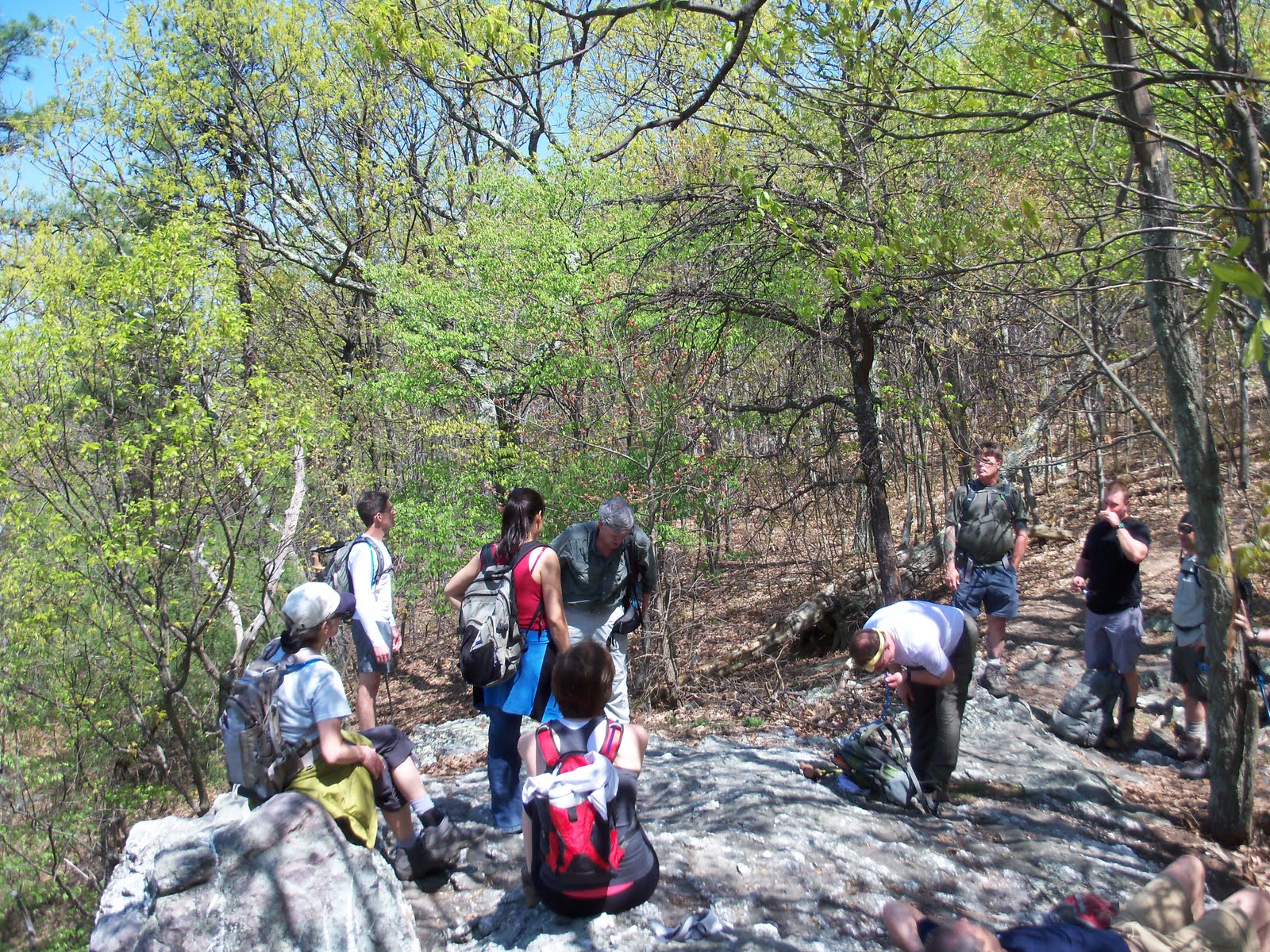 |
| One really slow guy would try and get in front of everyone after every break and then not move over to let you pass |
Back to the group mentality - I hear a lot of people becoming part of a group when on the Trail and beginning to hike with people. I have no intention of this. I like interacting with groups, and I hope to see the same people night after night at the shelter area, and even passing or being passed by the same characters. But I won't come to depend on others. I feel like this limits me and compromises my ability to make my own decisions and Hike My Own Hike. When part of a group, I put the group first, meaning the slowest and most in pain. That is my nature. If I'm committed to the group, then everyone is important within that group. This is good for many situations, but that is not the point of this trip. I am hiking the Appalachian Trail for myself. I've already come to the conclusion the the AT is a very selfish endeavor. It is the ultimate 'doing for oneself' and ignoring the exact wishes of loved ones. I have a T-shirt that says it all: 'It's All About ME' (ME is inside the state of Maine and the postal abbreviation of the state). I have been selfish before, but in a defeating way. I have, for several years now, turned that around and been positive, but I also had this underlying want to do something completely for myself in a good way. And I love Cara so much for being able to support me in this. I can't wait to support her in whatever selfishness 'for her only' thing comes upon her during her life! All that being said, I don't want to be apart of a group that limits me, or makes me do for someone other than myself. (I will help a hiker in need if I come upon one. I will give food, moral support, or even carry their pack... to the nearest road!)
When my friends come out and visit I will be catering to them, because I want to share this adventure with them. I want to share my love of nature and the outdoors. And I will NEED the support and promise of seeing people I care about out there. I will be looking for other people to build relationships with while out there as well. I will be open to making life-long friends. I want to care, and already do, about people that are out there already, even if they don't know it. I'm rooting for these people I may never meet to win thru!
 |
| Small groups with good people are VERY fun! |
Group dynamics are an odd thing as well. I often sit back and observe, and participate, but I normally try to be on the outskirts of a group with interaction with one or two people. Even while leading I do this. When groups divide and sides are taken I try to stay aloof, I do not want the drama. Some people crave drama as they crave the air they breathe! These people will create drama where there should be none. This class of people aren't bad people, they don't even know or realize that they do this intentionally and seemingly maliciously. I have seen it time and time again. Especially in the backpacking Meetup group. I figure even socially awkward people want to be part of groups, but for whatever reason, push people away. They go to these Meetups, and clash with other people that might be hard to be around, just like them. The Appalachian Trail is a very much solitary adventure. I perceive that those hikers able to hike and sleep alone do better and have a better chance of winning. I have read and seen some people on the Facebook AT page already get off because they can't be alone. One, D~, went with several people and the group split up the first day of the Trail - obviously the dynamic was discordant. D~ immediately attached herself to another guy that turned out to be nice and pack her pack and forget to put her cookset in it. Of course this was his fault so she said some mean things about him and ditched him. And immediately attached herself, post-haste, to yet another person. She gets lost going pee in the middle of the night and, according to her, would've wandered to her doom had it not been for her new friend. Soon after she quits the Trail. Promising to herself, and to anyone who will listen, that she will be back next year with a friend that will stick with her. I would like to see a study done on those that hike, an 'entrance poll' and a 'exit poll' of some kind, that asks some questions to get to the center of a hiker psychological profile. I feel the self-reliant are much much more likely to climb the other end, and the needy drop quicker than a ripe apple on a windy autumn day! This of course excludes injury, family, or monetary issues that can face any hiker on the Trail.
One guys' blog has him gushing. "I love it" "I hiked further than I thought" "This is awesome" That is the mentality to have, and the reason to be out there. Because the Appalachian Trail is such a selfish endeavor you shouldn't bother to be out there if you aren't loving most of it! Be selfish, don't be out there for anyone but yourself. On a hard day, use the disappointment others will feel in you to stay out there; ultimately that shouldn't be the deciding factor of staying out there, just a reason to follow the "Rules of Quitting"
Rules of Quitting:
1. Never quit on a gray day2. Never quit on a rainy day
3. Never quit on a very hot day
4. Never quit until you have that same decisive feeling for seven days in a row
5. Never quit in town!
6. Take a couple zeroes, eat lots of calories
7. Hike a few 5-mile days and see if that makes a difference
8. Your over-active brain is not always your friend on the trail
9. Never quit because people are passing you
10. Never judge any one else's decision to quit or hike on
- Borrowed from a former Thru Hiker
 |
| I will miss this |
 |
| And this |
Friday, March 2, 2012
Sign of the Times
Cara and I went with Kaya on a 7.5 mile hike around a lake. Apparently the only hiking trail of any length here in St Mary's County! It was a fun trail, lake on our left at most times, and bogs at our feet. Much of the trail had puddles and crossed many streams. At the start of the trail, I found this:
The trail around the lake was also blazed white. So I could feel like I was on the Appalachian Trail already. The spring Peepers were out in force, deafening in one spot. We knew the frogs were in the pond in front of us, but could not see a single one, the noise emenating from the grasses and water. Further along on the trail there were frogs eggs in a puddle in the trail, I'm rooting for those little guys to make it back up into the trees! We didn't see anyone for the first 5 miles, so I suggested we break a cardinal rule and allow the dog off leash just to see how she would react. She freakin' LOVED it. The sheer joy she had to run circles around us, jump in every puddle, and sniff out every bit of excrement in the area made her one happy pooch. She listened very well and came when called. Seeing the happiness on her face makes me understand a bit better why people so often let their dogs off lead. I don't agree with it if there is even a chance encounter with other people. When she comes and visits on the AT she will be kept on the leash, but on the back few miles of a lake with no one else around late-afternoon on a Thursday, it was fine and fun.
We Found Winter

Last week end Cara and I drove up to Ridgway Pennsylvania to go to the Chainsaw Carvers Rendezvous. We got to the dog-friendly Comfort Inn the night before and went to sleep fairly early. The next morning we went to the next town over to see my brother. Over night snow had fallen and was still falling, from 70 degree weather the day before in Maryland to below freezing temps in 'Up-State' PA - what a shock!! The event coordinators shafted my brother and the couple other carvers where he was placed. He was on the out-skirts of town over a bridge, down by the river, in his old Dodge van. The only commonality these carvers shared was that they were sleeping in their vehicles. All the other carvers got preferential treatment. Cara and I walked the town after catching up with my big bro. There were many people wandering around the town despite the cold harsh conditions. Had he been over there he would have sold out his stock. I was surprised, though, seeing many of the other carvers that seemed amateur, not too surprised, that he still made fairly good bank, despite being in BFE. There were some amazing carving there also. One carver had carved a horse so life likfe, the muscles rippled, the mane seemed to be stirred by the wind. The piece transcended carving to sculpture. The event ran the gambit, from sculptors to people that just picked up a chainsaw.
It was good to see Kevin and support him, I hope he appreciated it. It's a tough business he's in, and he really does do some lovely pieces.
We left Sunday as it was warming back up. Winter really has skipped Maryland. We have flowers coming up and blooming, and the tree out front will be blooming probably tomorrow! Spring is here, and I can't wait to walk north with it!
Preparation Updates
I have all my gear squared away, I have checked and triple checked my drop boxes. I have all the money I need saved. I have time off from work and a job waiting when I get back. Fortunately all my planning for the trip is done, now it's just waiting. I am taking four certification exams for work between now and when I leave, give my company one last boost as to why to want to keep me around! Plus it'll keep me occupied for the next month to study and pass all these tests!
Gear pictures for your enjoyment:
 |
| The Sign of the Times!! |
We Found Winter

Last week end Cara and I drove up to Ridgway Pennsylvania to go to the Chainsaw Carvers Rendezvous. We got to the dog-friendly Comfort Inn the night before and went to sleep fairly early. The next morning we went to the next town over to see my brother. Over night snow had fallen and was still falling, from 70 degree weather the day before in Maryland to below freezing temps in 'Up-State' PA - what a shock!! The event coordinators shafted my brother and the couple other carvers where he was placed. He was on the out-skirts of town over a bridge, down by the river, in his old Dodge van. The only commonality these carvers shared was that they were sleeping in their vehicles. All the other carvers got preferential treatment. Cara and I walked the town after catching up with my big bro. There were many people wandering around the town despite the cold harsh conditions. Had he been over there he would have sold out his stock. I was surprised, though, seeing many of the other carvers that seemed amateur, not too surprised, that he still made fairly good bank, despite being in BFE. There were some amazing carving there also. One carver had carved a horse so life likfe, the muscles rippled, the mane seemed to be stirred by the wind. The piece transcended carving to sculpture. The event ran the gambit, from sculptors to people that just picked up a chainsaw.
 |
| Over the river, not quite thru the woods. And more signs! |
We left Sunday as it was warming back up. Winter really has skipped Maryland. We have flowers coming up and blooming, and the tree out front will be blooming probably tomorrow! Spring is here, and I can't wait to walk north with it!
Preparation Updates
I have all my gear squared away, I have checked and triple checked my drop boxes. I have all the money I need saved. I have time off from work and a job waiting when I get back. Fortunately all my planning for the trip is done, now it's just waiting. I am taking four certification exams for work between now and when I leave, give my company one last boost as to why to want to keep me around! Plus it'll keep me occupied for the next month to study and pass all these tests!
Gear pictures for your enjoyment:
 |
| Compressed clothing bag |
 |
| The tent |
 |
| Slack pack bag/bear bag and food bag |
 |
| El Packa |
 |
| Ground pad |
 |
| Toiletries |
 |
| Flashlight |
 |
| Steripen - needs a better case so the button isn't randomly pressed |
 |
| Pocket Rocket |
 |
| 'Mess-kit' add salt shaker to this |
Monday, February 27, 2012
Trail Hygiene
The Appalachian Trail. Where people go to not shower regularly for 4 to 7 months.
That might not be the reason people go on the Trail, but is certainly one of the side effects. From all I've heard, if you can get a shower once a week you are going really well. So six months of having a shower every week - 26 showers. Rather than daily life of having at least one shower a day - less than a months worth of showers in 6. Well, see, look at how good it is for the environment to take a hike!
But this brings up some interesting questions about... well, a lot of things. How can one have friends while on the Trail? How can anyone allow hikers in their businesses? How do people stay in the same shelter or tent? The stench really must be enormous.
Beyond just not showering for long stretches, add in more exercise and NO deodorant (you don't want to attract bears to your arm pits while you sleep, do ya?!). There is also the penchant of many male hikers to not shave or get haircuts the entire time, not my style! The smell must truly seep into everything. The sleeping bag, clothing, pack - everything.
The Plan
All of this being said - I am planning on general bodily maintenance and trying to be somewhat clean under duress. I am going to shave and cut my hair regularly - I want to be able to do a quick check for ticks with out much cover in which they could hide. Also, I figure walking through summer time I will want to be as cool as possible. And for all those ounce counters I am getting rid of unneeded weight! I will either get Cara to bring the clippers when she comes to visit, or I will bounce box the clippers ahead.
I am bringing a one gallon light weight folding bucket. I can fill the bucket from the water source after hiking all day, pull some water from it for cooking and drinking and leave the bucket in the sun so it can warm up a bit before taking a basin bath to remove some of the sweat. I am bringing a chamois towel to dry off with and Dr.Bonners soap for all my soapy needs. I will be especially careful with my feet, bathing them daily and making extra sure they get plenty of time to air dry. The nails will be checked and clipped and cleaned as well. And blisters will be taken care of, hopefully, before they start. I would love to be one of those people that doesn't get blisters, but only time will tell.
I am bringing alcohol hand sanitizer to use after bathroom breaks and before meal preparation. I would say that more likely than getting a water borne intestinal infection from a polluted water source that unsanitary outhouses and fecal cross-contamination are way more likely to make hikers sick. Gross, right?! I know it and really want to prevent that crap (ba-dum). So the sanitizer will be easily accessible on the outside of the pack.
I will be brushing my teeth daily, obviously. I had enough of those little tiny tooth-pastes to put them in the drop boxes with my food.
Cara brought up the very good point of sun screen. That is something that I had not thought about, but will need to get. Normally I don't wear it because I don't burn. But it doesn't matter that I don't burn, I really need to protect my skin from damage. I'm going to be out-of-doors for a very extended and continual basis, and protection will be needed. I want to get the sun screen that also has bug repellent to lighten the load. I will need to make applying the lotion ("It rubs the lotion on its skin ") part of the daily routine at camp break down time and again at lunch.
I will need to be disciplined. More-so than I am on weekend camping trip. Weekend camping trips I normally am not as hygienic as I should be. I figure I'm there for a short time so I don't check my feet as thoroughly as I should, if at all. I don't basin bathe. I don't apply sun screen. But I will be out there for 6 months, that is my house, that is my life. I will need to change my normal short-timer mentality to adapt to the new life style. There is no bathroom to remind me to clean up. It's all on me. I will have plenty of downtime, in the afternoons, as I plan on waking early and hiking until 4 or 5, giving me plenty of day light hours to fix myself up.
Being stinky for days on end will be a change. This is part of the experience, to show how much of the world always lives. Even the shower a week is completely outside the bounds of many cultures. The Western ideal of daily showers and ultra cleanliness is outside the bounds of the majority of the world. This will open my mind as much as hiking every day. This change in life-style is one of the reasons I'm going, not to specifically be dirty, but to just have a change. The tinting on the glass through which I see the world will be different. I hope to be better off for all of it!
That might not be the reason people go on the Trail, but is certainly one of the side effects. From all I've heard, if you can get a shower once a week you are going really well. So six months of having a shower every week - 26 showers. Rather than daily life of having at least one shower a day - less than a months worth of showers in 6. Well, see, look at how good it is for the environment to take a hike!
But this brings up some interesting questions about... well, a lot of things. How can one have friends while on the Trail? How can anyone allow hikers in their businesses? How do people stay in the same shelter or tent? The stench really must be enormous.
Beyond just not showering for long stretches, add in more exercise and NO deodorant (you don't want to attract bears to your arm pits while you sleep, do ya?!). There is also the penchant of many male hikers to not shave or get haircuts the entire time, not my style! The smell must truly seep into everything. The sleeping bag, clothing, pack - everything.
The Plan
All of this being said - I am planning on general bodily maintenance and trying to be somewhat clean under duress. I am going to shave and cut my hair regularly - I want to be able to do a quick check for ticks with out much cover in which they could hide. Also, I figure walking through summer time I will want to be as cool as possible. And for all those ounce counters I am getting rid of unneeded weight! I will either get Cara to bring the clippers when she comes to visit, or I will bounce box the clippers ahead.
I am bringing a one gallon light weight folding bucket. I can fill the bucket from the water source after hiking all day, pull some water from it for cooking and drinking and leave the bucket in the sun so it can warm up a bit before taking a basin bath to remove some of the sweat. I am bringing a chamois towel to dry off with and Dr.Bonners soap for all my soapy needs. I will be especially careful with my feet, bathing them daily and making extra sure they get plenty of time to air dry. The nails will be checked and clipped and cleaned as well. And blisters will be taken care of, hopefully, before they start. I would love to be one of those people that doesn't get blisters, but only time will tell.
I am bringing alcohol hand sanitizer to use after bathroom breaks and before meal preparation. I would say that more likely than getting a water borne intestinal infection from a polluted water source that unsanitary outhouses and fecal cross-contamination are way more likely to make hikers sick. Gross, right?! I know it and really want to prevent that crap (ba-dum). So the sanitizer will be easily accessible on the outside of the pack.
I will be brushing my teeth daily, obviously. I had enough of those little tiny tooth-pastes to put them in the drop boxes with my food.
Cara brought up the very good point of sun screen. That is something that I had not thought about, but will need to get. Normally I don't wear it because I don't burn. But it doesn't matter that I don't burn, I really need to protect my skin from damage. I'm going to be out-of-doors for a very extended and continual basis, and protection will be needed. I want to get the sun screen that also has bug repellent to lighten the load. I will need to make applying the lotion ("It rubs the lotion on its skin ") part of the daily routine at camp break down time and again at lunch.
I will need to be disciplined. More-so than I am on weekend camping trip. Weekend camping trips I normally am not as hygienic as I should be. I figure I'm there for a short time so I don't check my feet as thoroughly as I should, if at all. I don't basin bathe. I don't apply sun screen. But I will be out there for 6 months, that is my house, that is my life. I will need to change my normal short-timer mentality to adapt to the new life style. There is no bathroom to remind me to clean up. It's all on me. I will have plenty of downtime, in the afternoons, as I plan on waking early and hiking until 4 or 5, giving me plenty of day light hours to fix myself up.
Being stinky for days on end will be a change. This is part of the experience, to show how much of the world always lives. Even the shower a week is completely outside the bounds of many cultures. The Western ideal of daily showers and ultra cleanliness is outside the bounds of the majority of the world. This will open my mind as much as hiking every day. This change in life-style is one of the reasons I'm going, not to specifically be dirty, but to just have a change. The tinting on the glass through which I see the world will be different. I hope to be better off for all of it!
Tuesday, February 14, 2012
Dreaming
There is a part of me, a large part of me, that thinks the dream of hiking the Appalachian Trail is still unattainable.
I have 2 dozen boxes of food in the basement. I have my gear packed. I have blogged and written, and re-written the same thoughts from a logical stand point. I have planned and crunched and gotten time off and spoken to friends and family for hours about going for a six month mountain jaunt. But it doesn't yet feel real.
The 50+ days standing between me and the Approach Trail is a gulf wider than I can see. The Trail, though conceived and idly turned within my mind, is over a distant horizon. My mind hums in anticipation, like a child waiting for Christmas, I have not felt the days between myself and something so acutely. It is agony, the anticipation, but it is also sweet. Sweet to want something, sweet to have something in life that makes me so honed in on the future.I will feel this way in the days leading up to marriage, or the days winding down to retirement. I can think of nothing else with such happy anticipation.
And yet apart of me hasn't yet accepted that I am going. A part of me feels that something will happen to prevent me from going. Will I feel this until the moment my foot breaks the plane under the arch at Amicalola? Will it take days after starting the Trail to sink in that I am really really walking the secret paths of the world, where the lonely look for a companionable fire, where the pilgrims all search for something they know not what?
Will I feel this way at the end of the Trail? Will I be as eager to come back? I will be missing Cara fiercely, I will be anticipating life again, hopefully not dreading work. But I feel seeing Katahdin will be bitter sweet, the end of a thing I have wanted to start for so long. Here I am, unable to imagine the beginning of the journey, imagining how I will feel at the end!
Monday, February 13, 2012
Gear in Review - Clothing
The List
Packa
REI shorts
REI Convertible pants
North Face synthetic T shirt
Minus 33 T-shirt
Stoic Base Layer
Synthetic Boxer briefs
3 pairs of wool socks
2 pairs of sock liners
bandana
REI Down vest*
Long Underwear*
Turtle Fur knit hat*
Fingerless Mitten gloves*
Ear/Neck thingie*
The Story
I have expounded on the virtues of the Packa before. And I will do so again! This piece of gear will be used daily as a pack cover on the (hopefully occasional) rainy day it will also be my rain gear. In camp it can either be strung up like a tarp or sat on to keep me bum dry. I found the Packa at Trail Days and Cara bought me the gear for Christmas and it looks as if it lives up to the (self generated) hype. Now all I gotta do is actually get the chance to use it! Cedar Tree, the thru hiker that invented and sells the Packa, gives it a warranty of 2000 miles, and from everything I've heard stands behind his product 100%. Not only do I like the idea of supporting a small shop and a former thru hiker, the product itself is is totally a great idea. Every feature a rain coat has it has, every feature a poncho has it has, every feature a pack cover has it has - except it has none of the draw-backs of any of those products!
I will be starting in early April. The day rushes toward me! From all I have heard, people starting in late March into early April can expect cold weather and at least the possibility of snow until they hit Damascus, VA, north of the Smokies. If my schedule holds true I will be passing thru Damascus during the second week of May. I have plans to send home the items followed by an asterisk when I hit town. The climb up Mount Rogers should be easy breezy!
Much clothing will be sent home when it warms up. I will be keeping a long sleeve shirt for the occasional chilly night and to change into while I wash my other clothing. Same with the pants (that can also be shorts). A change of clothes will be nice, and they are light. Also, having relatively clean camp clothing will be important, as well as having something to wear while washing my clothing is important.
I will be playing around with this the next few days to see how it fits into my pack, But this is generally what I take winter camping. I have been warm (or hot while hiking) with this gear into the teens. I may also trade out the sleeping bag once I hit Virginia, but that is covered in another post! I have packed what I want and left what I don't think I'll need. The dry compression sack with the clothes is smaller than a soccer ball and includes the chamois cloth that will serve as my towel. I left out from that the clothing on my back and a couple layers that I will be wearing or putting at the top of the pack for quick retrieval.
I have seen people wear hiking kilts, and some ultra-lighters with only the clothes on their backs. Then my brother says he would wear jeans because that's what he wears every day anyway, so why change it up? Clothing, like most everything else, is a matter of preference. This is one of the reasons I love the Appalachian Trail, there is no right way to do it. If you walk from GA to ME who cares how heavy/light fast/slow fat/happy you are?!
What are your experiences? Do you have a hiking 'uniform' you put on?
Packa
REI shorts
REI Convertible pants
North Face synthetic T shirt
Minus 33 T-shirt
Stoic Base Layer
Synthetic Boxer briefs
3 pairs of wool socks
2 pairs of sock liners
bandana
REI Down vest*
Long Underwear*
Turtle Fur knit hat*
Fingerless Mitten gloves*
Ear/Neck thingie*
 |
| Cold weather gear |
The Story
I have expounded on the virtues of the Packa before. And I will do so again! This piece of gear will be used daily as a pack cover on the (hopefully occasional) rainy day it will also be my rain gear. In camp it can either be strung up like a tarp or sat on to keep me bum dry. I found the Packa at Trail Days and Cara bought me the gear for Christmas and it looks as if it lives up to the (self generated) hype. Now all I gotta do is actually get the chance to use it! Cedar Tree, the thru hiker that invented and sells the Packa, gives it a warranty of 2000 miles, and from everything I've heard stands behind his product 100%. Not only do I like the idea of supporting a small shop and a former thru hiker, the product itself is is totally a great idea. Every feature a rain coat has it has, every feature a poncho has it has, every feature a pack cover has it has - except it has none of the draw-backs of any of those products!
I will be starting in early April. The day rushes toward me! From all I have heard, people starting in late March into early April can expect cold weather and at least the possibility of snow until they hit Damascus, VA, north of the Smokies. If my schedule holds true I will be passing thru Damascus during the second week of May. I have plans to send home the items followed by an asterisk when I hit town. The climb up Mount Rogers should be easy breezy!
 |
| Warm weather Gear |
Much clothing will be sent home when it warms up. I will be keeping a long sleeve shirt for the occasional chilly night and to change into while I wash my other clothing. Same with the pants (that can also be shorts). A change of clothes will be nice, and they are light. Also, having relatively clean camp clothing will be important, as well as having something to wear while washing my clothing is important.
I will be playing around with this the next few days to see how it fits into my pack, But this is generally what I take winter camping. I have been warm (or hot while hiking) with this gear into the teens. I may also trade out the sleeping bag once I hit Virginia, but that is covered in another post! I have packed what I want and left what I don't think I'll need. The dry compression sack with the clothes is smaller than a soccer ball and includes the chamois cloth that will serve as my towel. I left out from that the clothing on my back and a couple layers that I will be wearing or putting at the top of the pack for quick retrieval.
I have seen people wear hiking kilts, and some ultra-lighters with only the clothes on their backs. Then my brother says he would wear jeans because that's what he wears every day anyway, so why change it up? Clothing, like most everything else, is a matter of preference. This is one of the reasons I love the Appalachian Trail, there is no right way to do it. If you walk from GA to ME who cares how heavy/light fast/slow fat/happy you are?!
What are your experiences? Do you have a hiking 'uniform' you put on?
Thursday, February 9, 2012
Money money money!
It makes the world go round. It takes quite a bit of preparation and expense to hike the Appalachian Trail. When I decided I wanted to hike the Trail I arbitrarily decided that I wanted a certain amount of money as a safety net. I have not reached that goal, which was quite high, though I have a comfortable amount, I think.
Money makes the world go 'round,
Money leads hikers to town.
I have read many many many ad nauseum posts on White Blaze of someone asking how much money one needs to bring on the Trail. This is a very important question. And I can understand querying the masses.... if there weren't many easily searchable threads already pertaining to the very topic! All the threads on WhiteBlaze range from $3000 to $8000 for on-Trail expenses. And each past or future thru-hiker is very adamant and expressive as to why that is their number, mingled with the folks that remind everyone to HYOH (hike you own hike). With all that in mind I set a dollar amount, and additionally I have some rules for myself and some money saving methods I am going to try out.
If Money is the root of all evil,
then Roots in the Trail are Money.
I will reflect heavily on these pre-Trail thoughts after I'm done. I may find all these to be completely ridiculous and lackadaisically simple minded. But it's not from senselessness that I spout these opines. I have thought and re-thought and these are the logically thought-out methods I have concluded, I am hoping logic has clouded my delusions! Of course, rose-colored lenses and the romance of the Trail may have clouded my conclusions instead.
Allowance
I am doing this pre-Trail as well to get into the habit. Go to an ATM on a certain day and withdraw a certain amount, and X amount must last X days. Anything left over is a bonus for next time. If you are short, then either you get that much less next time, or just have some lean moneyless days. While driving back and forth to work it is more difficult to just have a moneyless day when the car demands fuel. On the Trail I will be allowing myself a certain amount every 2 weeks. Much of that time I will be in the woods with no one to exchange for services my hard won monies. In town's I want to limit myself the ability to splurge just for spending sake. It is very easy to swipe the card, but to have the cash in hand and see the pile dwindle makes it more real. I am looking for reality on this trip!
Tried an True Gear
The gear I have I have tried to test and use as much as possible. I also have purchased much of the gear from REI with an REI dividends credit card. REI allows you to return without question gear you can't use or don't like or begins to smell funny. While REI isn't the cheapest place in town, getting 5% back as well as being able to return anything for store credit forever saves money and space in my supply closet at home. Friends and family have been very accommodating and have really hooked me up with things I would not have otherwise thought that I could afford, such as boots, the Packa, SPOT, and good clothing. I would've "suffered" thru with more basic stuff - which would of had a chance of making me uncomfortable at the very least, or injured at the worst.
Pre-made meals
I have made all of the dinners for the entire trip in advance. I have nearly all of my lunches and breakfasts also made and ready to ship. Not only does this allow me to control my caloric intake, but I also have been able to buy in bulk and find deals on good quality highly nutritional meals. Not going into a grocery store in a small town while in the throes of the Hiker Hunger will save me money, and my meal diversity is substantial as well.
I have heard of others, including thru-hikers that are adamantly against mail-drops. Then I have also heard thru's just as loud for drops. So it is obviously a personal choice. Whether it's to spend a full day in town searching for food, re-packaging it into bags and then heading out, or my choice of hopefully grabbing what I need from the Post Office and tossing it in my bag before scooting out of town - it is a preference, not a necessity one way or the other.
Limit sleeping indoors
I am trying to stay out of towns as much as possible. Much of the adventure is the camaraderie one finds on the Trail and in the Trail towns, I will participate to the fullest extent, but I will be sleeping in my comfortable secluded little tent 13 of 14 days. If there is a hostel on the Trail that has that magic allure I will stay. I have some mail drops scheduled for deposit at Trail hostels, and I will be staying at those places for comfort, recuperation, and of all the stories I've heard of these places. But I don't have plans to stay in hotels often! My drop stops are in towns either on the Trail or in towns that are as close as possible to the Trail. I want the ability to get places without relying on taxis, shuttles, or my thumb!
Self control
The AYCE. Once the hunger sets in, I've heard these joints are hard, neigh impossible, to pass by! My budget will cover eating meals from towns whenever I want, however I want to control my urges, and stick to my prepared meals. This goes back to staying out of town! This goes for beer too. I will definitely want to have a tall cold one from time to time! But even the cheap beers add up quick! Six later and you've spent as much as you had the past week in food.
Very Good News, indeed!
I was asked last week to write a letter of intent to the President of the company for which I work. With a bit of trepidation I wrote several paragraphs outlining why I wanted to take off for 6 months of unpaid leave. Would he understand? Would he go with my supervisors recommendation of allowing me to go? Or would this be alien to him?
I received word today that the Prez has followed my bosses advice (THANK YOU MIKE!) and he is OK with me going.
I am reassured that I will have a job when I get back, that I have not done all this planning to have a final and unassailable road-block within sight of the start date, the Day of Ascension of Springer's Approach Trail. I will not be paid to be gone, obviously, but I have enough in savings to carry me. This does give me a "finish by" date. I gave myself a full 6 months to do the Appalachian Trail, though I have every intention of doing it in a maximum of 5 months. I really needed to add some cushion into the dates so I didn't hear a ticking throughout the trip. If I am injured or there is a family emergency or whatever the case may be, I have a window that is slightly longer than I need it to be. Additionally I will be able to use my accrued leave at the beginning of the trip, about a week and a half, to give me a boost monetarily.
Money makes the world go 'round,
Money leads hikers to town.
I have read many many many ad nauseum posts on White Blaze of someone asking how much money one needs to bring on the Trail. This is a very important question. And I can understand querying the masses.... if there weren't many easily searchable threads already pertaining to the very topic! All the threads on WhiteBlaze range from $3000 to $8000 for on-Trail expenses. And each past or future thru-hiker is very adamant and expressive as to why that is their number, mingled with the folks that remind everyone to HYOH (hike you own hike). With all that in mind I set a dollar amount, and additionally I have some rules for myself and some money saving methods I am going to try out.
If Money is the root of all evil,
then Roots in the Trail are Money.
I will reflect heavily on these pre-Trail thoughts after I'm done. I may find all these to be completely ridiculous and lackadaisically simple minded. But it's not from senselessness that I spout these opines. I have thought and re-thought and these are the logically thought-out methods I have concluded, I am hoping logic has clouded my delusions! Of course, rose-colored lenses and the romance of the Trail may have clouded my conclusions instead.
Allowance
I am doing this pre-Trail as well to get into the habit. Go to an ATM on a certain day and withdraw a certain amount, and X amount must last X days. Anything left over is a bonus for next time. If you are short, then either you get that much less next time, or just have some lean moneyless days. While driving back and forth to work it is more difficult to just have a moneyless day when the car demands fuel. On the Trail I will be allowing myself a certain amount every 2 weeks. Much of that time I will be in the woods with no one to exchange for services my hard won monies. In town's I want to limit myself the ability to splurge just for spending sake. It is very easy to swipe the card, but to have the cash in hand and see the pile dwindle makes it more real. I am looking for reality on this trip!
Tried an True Gear
The gear I have I have tried to test and use as much as possible. I also have purchased much of the gear from REI with an REI dividends credit card. REI allows you to return without question gear you can't use or don't like or begins to smell funny. While REI isn't the cheapest place in town, getting 5% back as well as being able to return anything for store credit forever saves money and space in my supply closet at home. Friends and family have been very accommodating and have really hooked me up with things I would not have otherwise thought that I could afford, such as boots, the Packa, SPOT, and good clothing. I would've "suffered" thru with more basic stuff - which would of had a chance of making me uncomfortable at the very least, or injured at the worst.
Pre-made meals
I have made all of the dinners for the entire trip in advance. I have nearly all of my lunches and breakfasts also made and ready to ship. Not only does this allow me to control my caloric intake, but I also have been able to buy in bulk and find deals on good quality highly nutritional meals. Not going into a grocery store in a small town while in the throes of the Hiker Hunger will save me money, and my meal diversity is substantial as well.
I have heard of others, including thru-hikers that are adamantly against mail-drops. Then I have also heard thru's just as loud for drops. So it is obviously a personal choice. Whether it's to spend a full day in town searching for food, re-packaging it into bags and then heading out, or my choice of hopefully grabbing what I need from the Post Office and tossing it in my bag before scooting out of town - it is a preference, not a necessity one way or the other.
Limit sleeping indoors
I am trying to stay out of towns as much as possible. Much of the adventure is the camaraderie one finds on the Trail and in the Trail towns, I will participate to the fullest extent, but I will be sleeping in my comfortable secluded little tent 13 of 14 days. If there is a hostel on the Trail that has that magic allure I will stay. I have some mail drops scheduled for deposit at Trail hostels, and I will be staying at those places for comfort, recuperation, and of all the stories I've heard of these places. But I don't have plans to stay in hotels often! My drop stops are in towns either on the Trail or in towns that are as close as possible to the Trail. I want the ability to get places without relying on taxis, shuttles, or my thumb!
Self control
The AYCE. Once the hunger sets in, I've heard these joints are hard, neigh impossible, to pass by! My budget will cover eating meals from towns whenever I want, however I want to control my urges, and stick to my prepared meals. This goes back to staying out of town! This goes for beer too. I will definitely want to have a tall cold one from time to time! But even the cheap beers add up quick! Six later and you've spent as much as you had the past week in food.
Very Good News, indeed!
I was asked last week to write a letter of intent to the President of the company for which I work. With a bit of trepidation I wrote several paragraphs outlining why I wanted to take off for 6 months of unpaid leave. Would he understand? Would he go with my supervisors recommendation of allowing me to go? Or would this be alien to him?
I received word today that the Prez has followed my bosses advice (THANK YOU MIKE!) and he is OK with me going.
I am reassured that I will have a job when I get back, that I have not done all this planning to have a final and unassailable road-block within sight of the start date, the Day of Ascension of Springer's Approach Trail. I will not be paid to be gone, obviously, but I have enough in savings to carry me. This does give me a "finish by" date. I gave myself a full 6 months to do the Appalachian Trail, though I have every intention of doing it in a maximum of 5 months. I really needed to add some cushion into the dates so I didn't hear a ticking throughout the trip. If I am injured or there is a family emergency or whatever the case may be, I have a window that is slightly longer than I need it to be. Additionally I will be able to use my accrued leave at the beginning of the trip, about a week and a half, to give me a boost monetarily.
Monday, February 6, 2012
Gear in Review - Backpack
Osprey Exos 58
Specs
Size: 58 liters
Weight: 2 lbs 8 oz
The Story
I have had this pack for over a year. I purchased it from REI after trying several on and doing research online. I had every intentions of this being the pack for the Appalachian Trail. I have a Kealty Redwing, which I love, but it is too small of a pack. I would stuff things into it for a weekend trip and almost be short of space. I knew I would not be able to fit all my gear and then add 7 days worth of food on top of everything. The Redwing is very comfortable, very durable pack, however it is heavy as a result.
The Osprey is very light, and still comfortable. The frame design is minimalist, the pads not solid, instead full of holes to allow air flow and reduce weight. The two mesh pockets on the belt are also very beneficial to hold a camera and a few bars for lunch.
I have used this pack on several weekend hikes, with never being in any discomfort. The size is great, and the pocket on the back is large and stretch to toss in a bladder of wine or a shed layer of clothing.
On one of the first times I used the pack I hooked my finger into one of the rope and plastic zipper pulls and tugged on it to get it closed. It immediately broke. So as a word, be gentle with the pulls, and grasp them, don't tug them. Other than that the durability is not questioned. This is the pack for my back while hiking the AT!
I have tested out all my gear, plus 8 days of food and 2 liters of water. The pack is comfortable and fits snuggly on my back. The weight is not bad at all. The Packa fits perfectly over the packs, and is easily accessible to convert into poncho too. I have nothing hanging off the pack and I have room to stuff things in the outside pocket too. All in all I am very satisfied with how the pack fits, weight distribution, and room.
Specs
Size: 58 liters
Weight: 2 lbs 8 oz
 |
| Loaded Osprey Exos 58 |
The Story
I have had this pack for over a year. I purchased it from REI after trying several on and doing research online. I had every intentions of this being the pack for the Appalachian Trail. I have a Kealty Redwing, which I love, but it is too small of a pack. I would stuff things into it for a weekend trip and almost be short of space. I knew I would not be able to fit all my gear and then add 7 days worth of food on top of everything. The Redwing is very comfortable, very durable pack, however it is heavy as a result.
The Osprey is very light, and still comfortable. The frame design is minimalist, the pads not solid, instead full of holes to allow air flow and reduce weight. The two mesh pockets on the belt are also very beneficial to hold a camera and a few bars for lunch.
I have used this pack on several weekend hikes, with never being in any discomfort. The size is great, and the pocket on the back is large and stretch to toss in a bladder of wine or a shed layer of clothing.
On one of the first times I used the pack I hooked my finger into one of the rope and plastic zipper pulls and tugged on it to get it closed. It immediately broke. So as a word, be gentle with the pulls, and grasp them, don't tug them. Other than that the durability is not questioned. This is the pack for my back while hiking the AT!
 |
| The Redwing - a good, but small pack |
Monday, January 30, 2012
Gear in Review - Camp Kitchen
The Skinny (which will hopefully keep me from getting skinny!)
MSR Pocket Rocket
I have the MSR Pocket Rocket. A funny name, right? It sounds dirty, which is probably why it makes me giggle. But that's where the laughing stops. This device is light, at 3 ounces. And powerful, able to boil water in a couple minutes. The Pocket Rocket is also tiny, fitting into a small plastic case to protect it.
I have used this stove extensively, in Zion, the Cascades, all over West Virgina, Virgina, Maryland, and New York. I've used it in every season. I have been satisfied with the performance, and the cost of this equipment. There is a long list of why this is a valuable, quality stove which I won't bore you with. It boils water, it simmers with some work (hold the pot or skillet a bit off the cooking platform), the canisters last a good amount of time.
The Good
Weight
Size
Name
Burn time
Price
I have some issues with the MSR Pocket Rocket though. The 3-pronged pot base is decently stable, but I am always aware of how I must be fairly exacting on placing the pot on the Pocket Rocket and with two cups of water watching it sway a little bit.
Also I had the great idea of putting a wind screen like a sleeve around the entire device and canister, as the wind has a huge, huge effect on the efficiency of this equipment. I did some research and found that what I was thinking about doesn't allow heat to escape and could make the canister explode, if I want a wind-screen I will be using my body, a shelter or a sleeping pad. I could probably engineer some tin-foil around just the cooking portion to keep the wind from effecting it too much.
The Not as Good
Stability
Lack of Wind-screen
The bottom line is that I will happily use this stove over the competition from ease of use, fuel type, weight and cost.
Cooking Food
For this next section I will be describing how I get food from course hard dry rice, to moist plump and delicious!
I will be posting soon a dissection of a food drop. To give you a taste I need to describe the types of food that I will be cooking. In the mornings I only have coffee water to heat up, the meals are breakfast cookies and bars, nuts, and dried fruit. Lunch is protein bars and shakes. Dinners will all be cooked, however all of the meals will not require dirtying a single dish. That's right, 6 months with no dishes! I will be using an Insulated Food Cozy. I found the product at Trail Days a couple years ago and I have tried it out every camping trip since. You have a freezer bag with your food in it. You boil water. You pour the water into the ziploc bag, stir, and place the bag inside of the Cozy, fold over the top and put it aside. Now, if you play the Harmonica, it is the time to play that instrument for 7 to 10 minutes. Viola! Your food is now tender enough to eat directly out of the freezer bag. How many dishes do you have to clean? None. Best idea ever.
So what will I do with rice? That method would leave it hard still. For this I will pour 1/2 the water I'm going to use into the bag at lunch time. The other half of the water I will follow the above steps. This method reduces my need for a cook set to a single metal mug that I can use for multiple purposes. Coffee in the morning, dinner in the evening. The entire cook set is a stove, a mug, a spork, and an insulated pouch.
Other Ingestion Related Gear
Steripen Adventurer + funnel pre-filter
The Story
What's small, light, easy to operate, and leaves no taste. If you said a Smart car, you're wrong. The Steripen is it, I tested it out in the Cascades in Washington. Granted that was water almost directly from glaciers, so it really didn't need to be treated most likely. Still it was easy to use. My only complaint is that is should have a small piece of rope, like a camera has, to put around your wrist. That way when you drop it, it doesn't sink to the bottom of your bottle.
The pre-filter removes particulates like leaf matter, water spiders, very small rocks, and churches (now read the last two in a British accent). Of course neither remove the taste of the water, so if you are getting water from a stagnant pond, it will still taste like frog slime. Then again, I know from personal experience that iodine tablets don't remove that flavor either!
Nalgen bottles
The Story
I have a water bladder, but I found that they are not for me. They are a pain to fill up, I have an irrational fear that I will poke a hole in it. And I have never actually gotten it to fit in my pack with my gear in the appropriate pouch, to refill it one must remove everything from the pack. Instead it ends up getting put under the top flap. Half the time the hose gets crinkled and I must take off the pack to get water anyway. A bottle is multi-use, easy to fill, easy to purify, indestructible, easy to clean after filling with wine, and cheap!
SeatoSummit folding bucket
The Story
A bucket is always useful, when the water source is far away, easier to let crap settle to fill the water bottles, a good way to let water warm up in the sun before taking bath. It is light-weight and has all kind of LNT principles as a reminder.
 |
| Seven days of dinners |
MSR Pocket Rocket
I have the MSR Pocket Rocket. A funny name, right? It sounds dirty, which is probably why it makes me giggle. But that's where the laughing stops. This device is light, at 3 ounces. And powerful, able to boil water in a couple minutes. The Pocket Rocket is also tiny, fitting into a small plastic case to protect it.
I have used this stove extensively, in Zion, the Cascades, all over West Virgina, Virgina, Maryland, and New York. I've used it in every season. I have been satisfied with the performance, and the cost of this equipment. There is a long list of why this is a valuable, quality stove which I won't bore you with. It boils water, it simmers with some work (hold the pot or skillet a bit off the cooking platform), the canisters last a good amount of time.
The Good
Weight
Size
Name
Burn time
Price
I have some issues with the MSR Pocket Rocket though. The 3-pronged pot base is decently stable, but I am always aware of how I must be fairly exacting on placing the pot on the Pocket Rocket and with two cups of water watching it sway a little bit.
Also I had the great idea of putting a wind screen like a sleeve around the entire device and canister, as the wind has a huge, huge effect on the efficiency of this equipment. I did some research and found that what I was thinking about doesn't allow heat to escape and could make the canister explode, if I want a wind-screen I will be using my body, a shelter or a sleeping pad. I could probably engineer some tin-foil around just the cooking portion to keep the wind from effecting it too much.
The Not as Good
Stability
Lack of Wind-screen
The bottom line is that I will happily use this stove over the competition from ease of use, fuel type, weight and cost.
Cooking Food
For this next section I will be describing how I get food from course hard dry rice, to moist plump and delicious!
I will be posting soon a dissection of a food drop. To give you a taste I need to describe the types of food that I will be cooking. In the mornings I only have coffee water to heat up, the meals are breakfast cookies and bars, nuts, and dried fruit. Lunch is protein bars and shakes. Dinners will all be cooked, however all of the meals will not require dirtying a single dish. That's right, 6 months with no dishes! I will be using an Insulated Food Cozy. I found the product at Trail Days a couple years ago and I have tried it out every camping trip since. You have a freezer bag with your food in it. You boil water. You pour the water into the ziploc bag, stir, and place the bag inside of the Cozy, fold over the top and put it aside. Now, if you play the Harmonica, it is the time to play that instrument for 7 to 10 minutes. Viola! Your food is now tender enough to eat directly out of the freezer bag. How many dishes do you have to clean? None. Best idea ever.
So what will I do with rice? That method would leave it hard still. For this I will pour 1/2 the water I'm going to use into the bag at lunch time. The other half of the water I will follow the above steps. This method reduces my need for a cook set to a single metal mug that I can use for multiple purposes. Coffee in the morning, dinner in the evening. The entire cook set is a stove, a mug, a spork, and an insulated pouch.
Other Ingestion Related Gear
Steripen Adventurer + funnel pre-filter
The Story
What's small, light, easy to operate, and leaves no taste. If you said a Smart car, you're wrong. The Steripen is it, I tested it out in the Cascades in Washington. Granted that was water almost directly from glaciers, so it really didn't need to be treated most likely. Still it was easy to use. My only complaint is that is should have a small piece of rope, like a camera has, to put around your wrist. That way when you drop it, it doesn't sink to the bottom of your bottle.
The pre-filter removes particulates like leaf matter, water spiders, very small rocks, and churches (now read the last two in a British accent). Of course neither remove the taste of the water, so if you are getting water from a stagnant pond, it will still taste like frog slime. Then again, I know from personal experience that iodine tablets don't remove that flavor either!
Nalgen bottles
The Story
I have a water bladder, but I found that they are not for me. They are a pain to fill up, I have an irrational fear that I will poke a hole in it. And I have never actually gotten it to fit in my pack with my gear in the appropriate pouch, to refill it one must remove everything from the pack. Instead it ends up getting put under the top flap. Half the time the hose gets crinkled and I must take off the pack to get water anyway. A bottle is multi-use, easy to fill, easy to purify, indestructible, easy to clean after filling with wine, and cheap!
SeatoSummit folding bucket
The Story
A bucket is always useful, when the water source is far away, easier to let crap settle to fill the water bottles, a good way to let water warm up in the sun before taking bath. It is light-weight and has all kind of LNT principles as a reminder.
Tuesday, January 17, 2012
Little Calf Mountain Reroute
http://www.southshenandoah.net/events/details/29-flyingmcleods-march
I just got a PATC memo with talks of a new mountain to be climbed in Shenandoah; the Trail re-reoute will now include Little Calf Mountain, with west-facing views.
I look forward to enjoying the hard work of those volunteers, and will need to re-pay their work with some volunteerism of my own!
Doing some research:
http://www.summitpost.org/little-calf-mountain-summit-view-bear-den-mountain/468975
Little Calf Mountain is at Mile Marker 99.5
Project Details
I just got a PATC memo with talks of a new mountain to be climbed in Shenandoah; the Trail re-reoute will now include Little Calf Mountain, with west-facing views.
I look forward to enjoying the hard work of those volunteers, and will need to re-pay their work with some volunteerism of my own!
Doing some research:
http://www.summitpost.org/little-calf-mountain-summit-view-bear-den-mountain/468975
Little Calf Mountain is at Mile Marker 99.5
Project Details
Gear in Review - Camera
This is the beginning of a Gear Review series that will cover the gear that I am using, that I have Trail tested and will update each review periodically as the trip progresses.

Panasonic Lumix DMC-TS3
Specs
-(Max. 18.4x combined with Optical Zoom without Extra Optical Zoom)
-(Max. 36.3x combined with Extra Optical Zoom)
Many other specifications are provided at the linked Panasonic wesite
The Story
Problem, I needed another camera! I had a fairly nice Kodak that had an unfortunate snow-boarding accident. I spent $100 to have it fixed, and the shots have never been the same, a tinge of blur on the left side of every picture taken.
I bought a cheaper Kodak and it also took nice pictures, had a decent zoom and was small and light-weight. A humid morning killed that camera in Dolly Sods! That's all it took. The camera was in a plastic bag, it had rained the night before but the camera was in a bag in a backpack with a rain cover under a tarp. And yet when I removed the camera from the bag to take a picture of a gorgeous sunrise from Bear Rocks, the screen became full of condensation and the camera breathed it's last, even after instantly removing the battery, and putting the camera in the freezer when I got home.
After going through two cameras in less than a year I was determined to get one that could live through my life-style, that is outside and on the go, with occasional bumps and bruises. I began searching and came upon several cameras that styled themselves as 'ruggedized'. After reading reviews, and having worked for a couple years with Panasonic Toughbook ruggedized laptops, I decided to go with the Panasonic Lumix DMC-TS3... the only problem was that it hadn't been released yet! The TS2 was still being sold, but heading towards EOL. I decided to wait it out, put in a pre-order and go without a camera for a few months, with the hopes that it would arrive in time to go to Stehekin, WA for the Volunteer Vacation. The camera did arrive in time.
The camera took hundreds of very nice pictures, the battery life was good. The GPS, altimeter, barometer, and compass were nice features. After using the camera for 9 days we were hiking back to base camp with tools in hand. The shovel I carried banged, and not hard, into the camera that was in my cargo pocket. The back LCD screen cracked and spider-webbed. The camera still took pictures just fine, but with the screen compromised I figured the water-proofing was also compromised.
After the trip I sent the camera back to Panasonic, free of charge for warranty repair. The LCD screen was back-ordered for over a month, and a couple months after sending it in I got a fixed camera back. While I'm glad they made good on it, it took way too long.

Conclusion
The pictures are decent, the stabilization is good, the color is true. However, you must understand that the zoom is not great the lens is contained within the housing so optical zoom is limited, and digital zoom always becomes lossy very quickly. The camera is rugged, but from experience, not invincible. I have taken pictures with it while swimming, but I would not go scuba diving with it, though I would probably go snorkeling.
The GPS takes forever to find satellites and it really must be under clear unobstructed skies. Even with the GPS left on the battery lasts for a long time, several days of constant use. In the time I was in Washington I changed the battery once.
All in all I'm glad I purchased the camera and it will be traveling the Appalachian Trail with me.

Self-timer used
Panasonic Lumix DMC-TS3
Specs
Features
-Shockproof
-Waterproof
-Dustproof
-Freezeproof
-Altimeter / Depth Indicator / Compass / Barometer / GPS
-12.1 mega Pixel
-28mm Wide-angle Lens
Focus
-Optical: 4.6x
-Extra Optical: 5.7x (4:3 / 8M), 7.3x (4:3 / 5M), 9.1x (4:3 / under 3M)
-Intelligent: 6x
-Digital: 4x -(Max. 18.4x combined with Optical Zoom without Extra Optical Zoom)
-(Max. 36.3x combined with Extra Optical Zoom)
Many other specifications are provided at the linked Panasonic wesite
The Story
Problem, I needed another camera! I had a fairly nice Kodak that had an unfortunate snow-boarding accident. I spent $100 to have it fixed, and the shots have never been the same, a tinge of blur on the left side of every picture taken.
I bought a cheaper Kodak and it also took nice pictures, had a decent zoom and was small and light-weight. A humid morning killed that camera in Dolly Sods! That's all it took. The camera was in a plastic bag, it had rained the night before but the camera was in a bag in a backpack with a rain cover under a tarp. And yet when I removed the camera from the bag to take a picture of a gorgeous sunrise from Bear Rocks, the screen became full of condensation and the camera breathed it's last, even after instantly removing the battery, and putting the camera in the freezer when I got home.
After going through two cameras in less than a year I was determined to get one that could live through my life-style, that is outside and on the go, with occasional bumps and bruises. I began searching and came upon several cameras that styled themselves as 'ruggedized'. After reading reviews, and having worked for a couple years with Panasonic Toughbook ruggedized laptops, I decided to go with the Panasonic Lumix DMC-TS3... the only problem was that it hadn't been released yet! The TS2 was still being sold, but heading towards EOL. I decided to wait it out, put in a pre-order and go without a camera for a few months, with the hopes that it would arrive in time to go to Stehekin, WA for the Volunteer Vacation. The camera did arrive in time.
The camera took hundreds of very nice pictures, the battery life was good. The GPS, altimeter, barometer, and compass were nice features. After using the camera for 9 days we were hiking back to base camp with tools in hand. The shovel I carried banged, and not hard, into the camera that was in my cargo pocket. The back LCD screen cracked and spider-webbed. The camera still took pictures just fine, but with the screen compromised I figured the water-proofing was also compromised.
After the trip I sent the camera back to Panasonic, free of charge for warranty repair. The LCD screen was back-ordered for over a month, and a couple months after sending it in I got a fixed camera back. While I'm glad they made good on it, it took way too long.

Conclusion
The pictures are decent, the stabilization is good, the color is true. However, you must understand that the zoom is not great the lens is contained within the housing so optical zoom is limited, and digital zoom always becomes lossy very quickly. The camera is rugged, but from experience, not invincible. I have taken pictures with it while swimming, but I would not go scuba diving with it, though I would probably go snorkeling.
The GPS takes forever to find satellites and it really must be under clear unobstructed skies. Even with the GPS left on the battery lasts for a long time, several days of constant use. In the time I was in Washington I changed the battery once.
All in all I'm glad I purchased the camera and it will be traveling the Appalachian Trail with me.
Wednesday, January 11, 2012
Class of 2012
Already the Class is forming. People are in planning and excitement mode.
I've visited Trail Days in Damascus, VA the last two years. There is a hiker parade as the main event. Main St is shutdown, the crowd forms - many with squirt guns and water balloons (I assume to wash off the Hiker Stench) - and different Classes hike down the street. Some people wear their hiker garb, others wear diapers (no idea how that tradition started), others costumes. The Classes stretch back decades. These classes are a tight knit group of the larger tight knit Trail community itself. Some groups go further and camp in the same "towns" in group camping. These folks have shared experiences, their stories are inter-woven with one another. The events that happened that year on the Trail, weather or tragedy or hilarity, traveled via word of mouth and registry to many hikers that year, cementing a bond between them. This is something I am very much looking forward to.

These people, fellow adventurers, intrepid travelers all, will be my Classmates. I may never meet some, but they will still have a large effect on me. I will be reading their entries in the shelter registers, I will get to know their sense of humor, their frustrations, and I will look forward to news from up-Trail. Those following me will do the same. If I do finally run (or rather walk) into these hikers, I will have an understanding and feel a sense of kinship to them that they won't have for me if they have never read my musings in the registers.
I have already had the pleasure of reading the words laid down by a couple bloggers that are hiking this year. I am looking forward to reading future posts, both on the Internet and in the registers, as both are beginning before me. Laughing Dog and Appalachian Jake are two that I have found so far. Both are good reads, and give me insight into them. Meeting them will be a pleasure.
I have done some research and the more research I do the more blogs and resources I find concerning the upcoming 2012 season. Since the Good Badger has already begun a list of bloggers, I will link his site, and let you do some of your own research. I will be adding all these to Google Reader (RSS is a wonderful thing) so I can follow along.
I see a buzz on White Blaze about those that are preparing to hit the AT in 2012 as well. There are also a bunch of Facebook groups 1, 2, 3, 4, 5, 6
And since I'm a fan of Google+ this blog has it's very own Page for micro-blogging.
More prep talk
On other fronts I completely re-did my shipping schedule and ironed out the areas that I had as gray-areas (Shenandoah and White Mountains). I am pleased with the amounts of time between drops, and the closeness to the Trail. Most I have are within a mile, usually less. I have setup an average of 13 miles per day between drops. I guess the part I may regret and need to change is the length of time between drops. I am planning on some of two or three days, however most drops are for 7 days with a few 8 or 9 days (110+ miles between drops). This may be way too heavy. In the next few weeks I will be loading my pack with all my intended gear, water, and the heaviest amount of food I will be carrying. Virginia has some very long ridge walks, and the southern New England states are, well let's face it, they're easy - comparatively. I have read probably over a dozen journals and books of peoples experience on the Trail. Everyone talks of the hard the beginning, the length of Virginia, the rocks of Pennsylvania, and then the Green Mountains. There are several states, CT, MA, NY, NJ that people say, "another state - woohoo!" and that's about it. That being said, I have also heard those states are very pretty, and I am looking forward the the N.E. stroll (I hope it won't be too hot this summer). I hope that 1 weeks worth of food will not be too much on my back. I am trying to minimize time in town, either having to wait until the Post opens or getting drawn in to all the town calories($)! My meals are light and have high nutritional value, the Harmony House meals are very light! The packets of chicken and the summer sausage both are a bit heavier since they both have some moisture weight, but those will be eaten first!
Pack List
I found a nice web-site that has an enormous library of user generated item weights, as well as the capability of adding your own. It is a work in progress, since I'm not completely a gram-weeny I don't have too much concern with the exact weight of every single item. I care more about the approximate weight just for reference. Once I'm on the Trail for a few weeks, and the handle of my tooth brush is cut off, then you can call me an ounce-counter!
I've visited Trail Days in Damascus, VA the last two years. There is a hiker parade as the main event. Main St is shutdown, the crowd forms - many with squirt guns and water balloons (I assume to wash off the Hiker Stench) - and different Classes hike down the street. Some people wear their hiker garb, others wear diapers (no idea how that tradition started), others costumes. The Classes stretch back decades. These classes are a tight knit group of the larger tight knit Trail community itself. Some groups go further and camp in the same "towns" in group camping. These folks have shared experiences, their stories are inter-woven with one another. The events that happened that year on the Trail, weather or tragedy or hilarity, traveled via word of mouth and registry to many hikers that year, cementing a bond between them. This is something I am very much looking forward to.

These people, fellow adventurers, intrepid travelers all, will be my Classmates. I may never meet some, but they will still have a large effect on me. I will be reading their entries in the shelter registers, I will get to know their sense of humor, their frustrations, and I will look forward to news from up-Trail. Those following me will do the same. If I do finally run (or rather walk) into these hikers, I will have an understanding and feel a sense of kinship to them that they won't have for me if they have never read my musings in the registers.
I have already had the pleasure of reading the words laid down by a couple bloggers that are hiking this year. I am looking forward to reading future posts, both on the Internet and in the registers, as both are beginning before me. Laughing Dog and Appalachian Jake are two that I have found so far. Both are good reads, and give me insight into them. Meeting them will be a pleasure.
I have done some research and the more research I do the more blogs and resources I find concerning the upcoming 2012 season. Since the Good Badger has already begun a list of bloggers, I will link his site, and let you do some of your own research. I will be adding all these to Google Reader (RSS is a wonderful thing) so I can follow along.
I see a buzz on White Blaze about those that are preparing to hit the AT in 2012 as well. There are also a bunch of Facebook groups 1, 2, 3, 4, 5, 6
And since I'm a fan of Google+ this blog has it's very own Page for micro-blogging.
More prep talk
On other fronts I completely re-did my shipping schedule and ironed out the areas that I had as gray-areas (Shenandoah and White Mountains). I am pleased with the amounts of time between drops, and the closeness to the Trail. Most I have are within a mile, usually less. I have setup an average of 13 miles per day between drops. I guess the part I may regret and need to change is the length of time between drops. I am planning on some of two or three days, however most drops are for 7 days with a few 8 or 9 days (110+ miles between drops). This may be way too heavy. In the next few weeks I will be loading my pack with all my intended gear, water, and the heaviest amount of food I will be carrying. Virginia has some very long ridge walks, and the southern New England states are, well let's face it, they're easy - comparatively. I have read probably over a dozen journals and books of peoples experience on the Trail. Everyone talks of the hard the beginning, the length of Virginia, the rocks of Pennsylvania, and then the Green Mountains. There are several states, CT, MA, NY, NJ that people say, "another state - woohoo!" and that's about it. That being said, I have also heard those states are very pretty, and I am looking forward the the N.E. stroll (I hope it won't be too hot this summer). I hope that 1 weeks worth of food will not be too much on my back. I am trying to minimize time in town, either having to wait until the Post opens or getting drawn in to all the town calories($)! My meals are light and have high nutritional value, the Harmony House meals are very light! The packets of chicken and the summer sausage both are a bit heavier since they both have some moisture weight, but those will be eaten first!
Pack List
I found a nice web-site that has an enormous library of user generated item weights, as well as the capability of adding your own. It is a work in progress, since I'm not completely a gram-weeny I don't have too much concern with the exact weight of every single item. I care more about the approximate weight just for reference. Once I'm on the Trail for a few weeks, and the handle of my tooth brush is cut off, then you can call me an ounce-counter!
Subscribe to:
Posts (Atom)